Before the Sideboard: A Brief History of the Serving Table
The history of the serving table traces its shift from meal service to everyday display, helping you recognize the form and understand its changing role.
Why did the serving table stay in the dining room after the dishes were cleared? The history of the serving table starts with a practical job: keeping food and tableware close at hand, then leaving a useful surface behind when the meal ended. Its changing role is less a story of one invention than of familiar furniture taking on new duties.
Serving tables at work
In a dining room, a serving table gave dishes, serving utensils, and other meal necessities a place apart from the table where people ate. Its value was practical. A host or server could set down a platter, arrange plates, or keep a dish within reach without taking up space among the diners.
The label did not describe one fixed design. A serving surface might be a narrow table against a wall or a more substantial piece with drawers and shelves. The shared feature was its position in the routine of a meal: near enough to help, but not the place where everyone sat.
That distinction matters more than a precise family tree of furniture names. Terms such as serving table, sideboard, buffet, and console have varied across makers and periods. Without tying a particular label to a specific catalog or place, it is safer to describe the function than to claim a single origin for the form.
From service to display
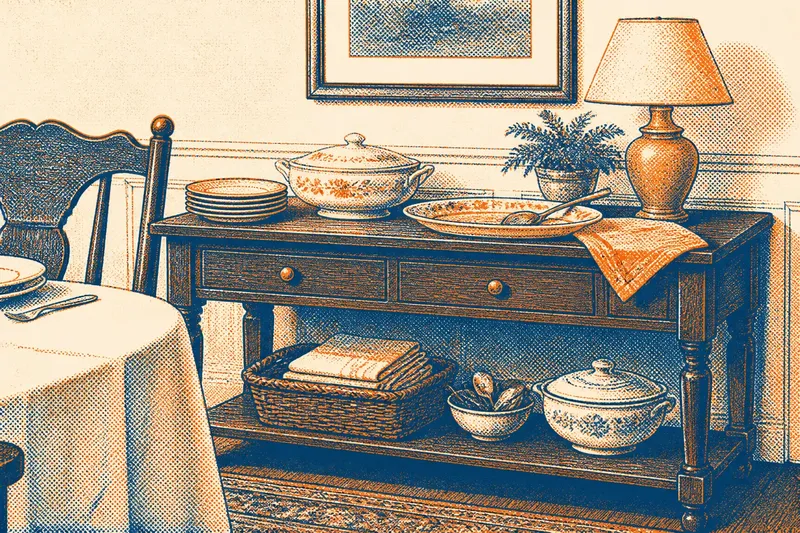
A surface used for meals does not need to stay empty between them. A lamp, bowl, or framed picture could occupy the top when no one was serving food. Drawers or shelves could keep table linens and utensils close by. The table’s purpose broadened through ordinary use, not through a sudden change in its basic shape.
As dining rooms came to include furniture for different tasks, a serving table could sit alongside a dining table and storage cabinets. The pieces were not interchangeable: one gathered diners, another held meal items, and a cabinet kept objects out of sight. In practice, however, a household could ask one piece to do more than one of these jobs.
This helps explain the overlap among common names:
- A serving table emphasizes a reachable surface for meal items.
- A console table often has a slim profile intended for a wall or passage.
- A sideboard usually suggests a cabinet with enclosed storage.
- A buffet commonly describes a piece or arrangement used to set out food.
These are useful distinctions, not binding definitions. A shop’s label may differ from an older description, and a piece can serve as both storage and display without needing a new name.
Furniture names in context?
What is the difference between a serving table and a sideboard?
A serving table is commonly identified by its use as a surface for meal service. A sideboard usually puts more emphasis on cabinet storage, though the terms overlap in everyday listings.
How does a buffet differ from a serving table?
Buffet can refer to the arrangement of food as well as to a dining-room storage piece. A serving table describes the supporting surface more generally, so the names can describe the same object from different angles.
Why might a serving table hold display objects?
When it is not needed for dishes, its top remains a convenient place for objects used or enjoyed in the room. This second use does not erase its service function; it makes the surface useful between meals.
Is a console table another name for a serving table?
Not necessarily. Console usually points to a narrow form suited to a wall or passage, while serving table points to a role. One piece can fit both descriptions if its shape and use support them.
Changing domestic routines
The shift from service to display is easiest to understand as a change in routine. A household that served food in the dining room might keep the top mostly clear and move a lamp aside at mealtime. A household that rarely used the room for meals might leave the lamp in place and treat the table as a display surface.
Storage changed the balance, too. Drawers could hold napkins or serving tools; shelves could keep baskets or other frequently used objects accessible. A piece with doors concealed supplies when they were not in use. None of these features made a serving table a different object by itself. They gave households more ways to use it.
Imagine a household with a dining room used for ordinary evening meals and little other storage. They have a table with two drawers and an open shelf. They place napkins and serving utensils in the drawers, placemats in a basket below, and a lamp at one end of the top. When dinner is served, they move the lamp to a nearby shelf and use the cleared area for dishes. The result is a piece that supports both routines, with one small rearrangement rather than a change of furniture.
Reading the form today
The history of the serving table is useful because it explains why the form can be read in more than one way. Its association with meals remains visible in a clear, reachable top; drawers and shelves suggest storage; a lamp or bowl reflects its quieter role between meals. The same piece can carry these clues at once.
When comparing a serving table with a sideboard or console, start with what each name emphasizes. Ask whether the piece is being described by its function, its shape, or its storage. That distinction makes old labels and current listings easier to understand, even when the vocabulary refuses to behave like a tidy filing system.
A serving table’s lasting place in a room comes from this flexibility. It can support a meal, hold useful objects, or simply provide a surface along a wall. Its history is not a straight march from service to decoration; it is a record of those uses sharing the same piece of furniture.