Why a Doorway Changes the Way a Room Is Read
Why a doorway changes the way a room is read: see how its position frames views, directs movement, and shapes the impression of connected rooms.
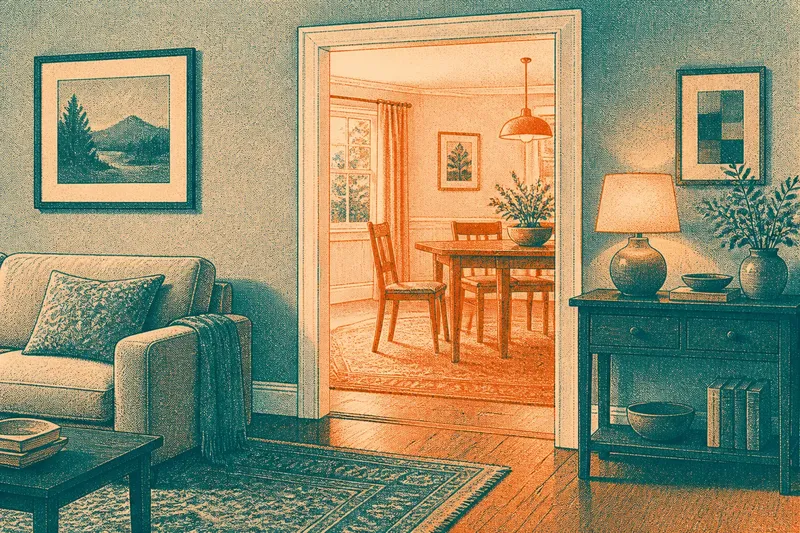
Why does the same pair of rooms feel open from one doorway and awkward from another? A doorway changes the way a room is read by deciding what appears first, what stays hidden, and where the body seems invited to go. Its opening is not merely a gap in a wall. It is a frame, and the view inside that frame can make connected rooms feel continuous, separate, or oddly at odds.
Imagine Mara, in an invented situation, moving into a home where the living room opens toward a dining room through a doorway near one corner. From the hall, the opening shows the dining table’s short end, a chair pulled out, and a narrow strip of the living room. The rooms are physically connected, but the view gives neither one a clear welcome. Mara’s task is not to make the rooms match. It is to understand what the doorway is already asking a visitor to see and do.
The First View
Stand on the approach side of a doorway and notice the first complete object or surface visible beyond it. That first view often becomes a room’s informal introduction. A table, fireplace, window, or sofa can make a legible focal point. A chair back, open closet, or the edge of a tall cabinet can make the same space seem interrupted before anyone has entered.
The opening crops the room much as a picture frame crops a scene, but the effect changes with the viewer’s position. From the hall, Mara sees the dining table at an angle. From beside the living room sofa, the table disappears behind the wall. A person approaching from the kitchen gets a different view again. The doorway therefore gives no single, universal reading of either room. It offers a sequence of partial views.
Try looking from the places people actually pause: the hall, the end of a sofa, the kitchen entrance, or the spot where someone might wait for another person. Notice what the wall conceals and what the opening reveals. This is more useful than judging the doorway from the center of an empty room, where nobody is likely to stand for long.
The Path Through
A doorway also makes a quiet suggestion about movement. If the opening lines up with a clear route, a person can understand where to go without looking for instructions. If it points toward a table corner or a chair’s back, the rooms may appear to collide, even when there is enough floor space to pass comfortably.
Mara follows the natural route from the hall into the living room and onward toward the dining room. The corner doorway catches this path at an angle. A visitor stepping through sees the dining table but must turn around the sofa before reaching it. The view and the route disagree: the table looks like the destination, while the furniture suggests a detour.
She does not need to shift every furnishing. First, she checks whether the chair by the table can be pushed in, whether the sofa is crowding the route, and whether the doorway’s approach is being treated as a standing place or a passage. Those observations separate a genuine circulation problem from a view that merely feels busy. A room can be visually calm while still having a cramped route, and vice versa.
The Corner Opening
A doorway near a corner has a particular effect. It tends to reveal one side of the next room and hide the other, creating an oblique view rather than a centered one. This can give rooms a sense of privacy, because the whole scene does not announce itself at once. It can also make the connection feel accidental if the first visible objects have no clear relationship to the route.
In Mara’s living room, the opening reveals the dining table’s short end and the chair nearest the wall. The table appears tucked away, while the pulled-out chair occupies the center of the frame. The arrangement is not inherently wrong. It simply gives the doorway a story about the chair rather than about the dining area.
She tries a modest, reversible change: the chair is returned to the table, and a small lamp on the living room console is turned so its light is visible from the hall. The expected observable result is a tidier first view, with a warm point of light leading the eye toward the opening rather than a chair projecting into it. The doorway remains in the same place; the view becomes easier to parse.
Connected Rooms, Separate Roles
Connected rooms do not need to be visually identical. The doorway can help establish a relationship without erasing the difference between them. A repeated material, a shared color note, or a visible object that belongs to both views can make the rooms feel related. Repeating every finish and shape can instead make the threshold feel like a display of coordination.
Mara’s living room has a dark wood console, while the dining table is a lighter wood. From the hall, the console is visible through the doorway’s near edge, and the table appears beyond it. She keeps both pieces. A framed print above the console includes a muted green that also appears in the dining room’s centerpiece. The small echo helps the rooms connect, while their different furniture and uses remain clear.
The distinction matters most when one room is meant to be quieter or more private. A doorway that gives a direct view of the whole room can make it feel exposed. A partial view may be welcome, especially where the room has a distinct purpose. Curtains, screens, or furniture should not be added automatically to solve an impression problem; they alter light, access, and sightlines, not just appearance.
What Should the Doorway Show?
What should be visible first?
Choose a view that gives the room a readable point of arrival, such as a table edge, a window, or a lamp. The object need not sit directly in the doorway’s center; it should simply make sense from the approach.
Should the rooms match?
No. A shared color, material, or shape can signal a connection without making both rooms perform the same role. Let the doorway reveal enough continuity to feel intentional, while allowing each room to keep its own character.
How can a doorway feel less crowded?
Look for objects that project into the opening’s view or interrupt the route, then consider whether their placement can change. A chair pulled under a table or a lamp shifted off the visual center may help without adding another piece of furniture.
Does the opening need to be centered?
No. An off-center opening can create privacy, an angled view, or a useful division between activities. The relevant question is whether the view and the path through the rooms make sense for the people using them.
A Readable Threshold
Mara’s finished arrangement is deliberately restrained. From the hall, the visitor sees the console’s lamp and a clearer glimpse of the dining table. Through the opening, the route remains open around the sofa. The two rooms still have different furniture and functions; the doorway no longer makes their relationship feel like an accident.
The useful lesson is to assess a doorway from both sides and from the route people take, not only from a favorite standing spot. If the first view is confusing, adjust the objects within that view before considering larger changes. And if the route itself is uncomfortable, treat that as a circulation question rather than a styling problem. A doorway earns its place in the room’s composition by showing enough, concealing enough, and letting people pass without having to negotiate with a chair.